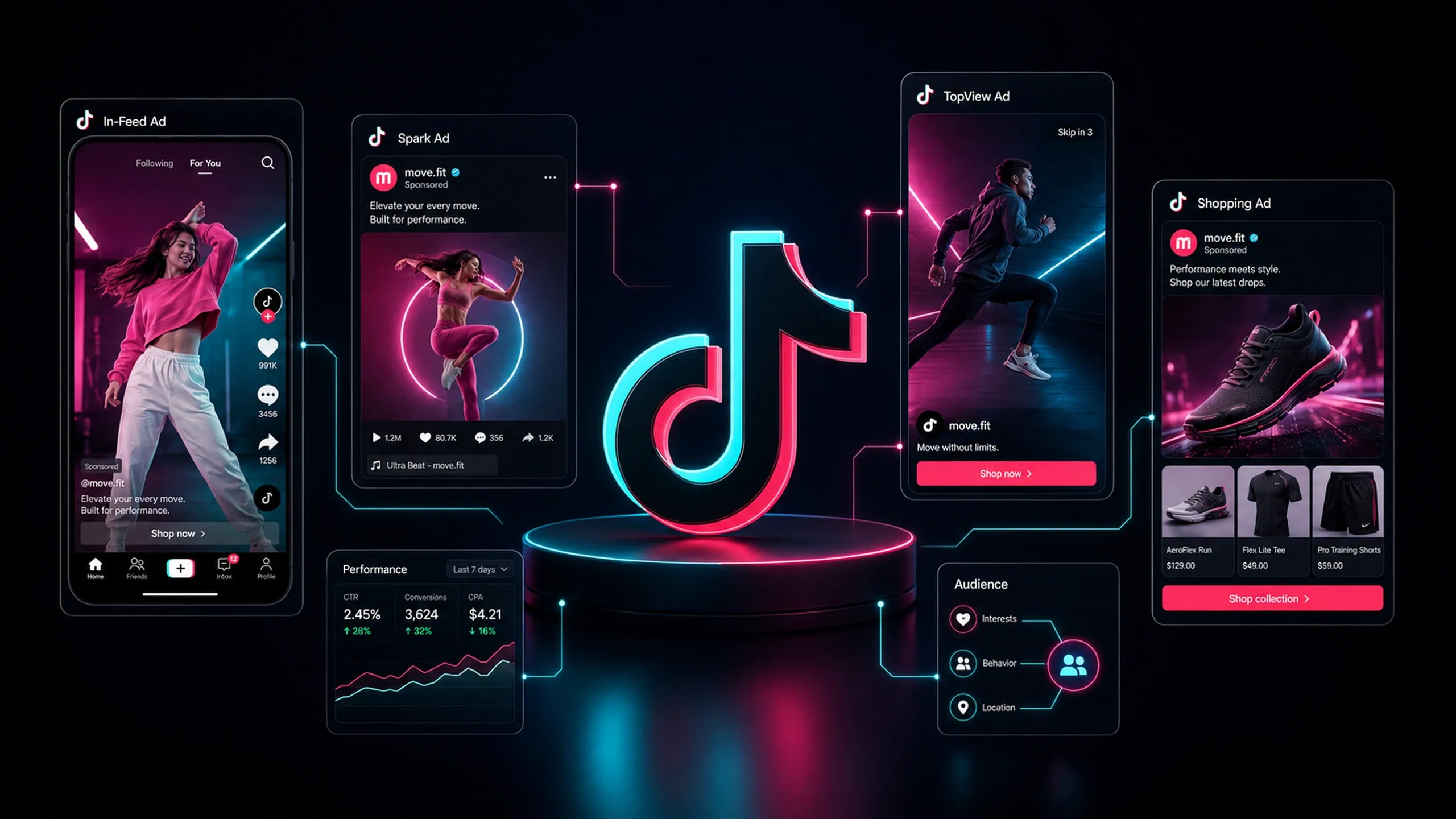
TikTok Ads
Performance Advertising in a Creative Discovery Feed
TikTok Ads is a paid advertising platform built around short-form video, creative discovery, algorithmic delivery, and increasingly automated campaign systems.
It should not be treated as a place to simply resize ads from other platforms. TikTok has its own behavior, pace, creative language, and attention patterns.
A campaign performs when the objective, creative, audience signal, placement strategy, conversion tracking, and post-click journey are aligned well enough for TikTok’s system to learn.
TikTok Ads works best when creative feels native to the platform, conversion signals are clean, and campaigns are structured around measurable business outcomes.
What TikTok Ads Are
TikTok Ads are paid placements delivered through TikTok Ads Manager and related TikTok for Business tools.

The platform is built around video-first discovery, entertainment, creator behavior, algorithmic recommendations, social proof, and fast creative testing.
TikTok Ads can support reach, traffic, video views, community interaction, lead generation, app promotion, sales, TikTok Shop, website conversions, and creator-led distribution depending on campaign setup and account eligibility.
TikTok’s current objective framework groups objectives into Awareness, Consideration, and Conversion. The documented objectives include Reach, Traffic, Video Views, Community Interaction, Branded Mission, App Promotion, Lead Generation, and Sales.
That makes TikTok more than a pure awareness channel.
It can drive measurable outcomes, but only when creative, tracking, landing pages, product experience, and campaign setup match how people actually use the platform.
Why TikTok Ads Work
TikTok Ads work because the platform is designed around discovery.
People do not only follow accounts they already know. They encounter content through recommendation patterns, creative hooks, interests, behavior, and engagement signals.
This gives advertisers a powerful opportunity: a business can reach people before they search, before they compare, and before they have fully defined the problem.
That opportunity also creates risk.
TikTok users move quickly. Weak creative gets ignored. Overly polished ads can feel out of place. Generic claims rarely hold attention. A slow hook, unclear value, or disconnected landing page can waste the click before the campaign has a chance to learn.
TikTok rewards creative clarity, volume, variation, and speed of learning.
The platform is strongest when advertisers treat creative as the core performance input, not the final decoration added after the media plan.
TikTok Campaign Objectives
TikTok campaign objectives define what the system should optimize toward.
The objective should match the business goal and the stage of the user journey.
Reach
Reach is designed to show ads to the maximum number of people in the target audience.
This objective is useful for awareness, launches, cultural moments, local visibility, product announcements, and broad message distribution.
It should not be judged only by direct conversions. Reach campaigns can support the top of the funnel, but they need a clear reason to exist.
Traffic
Traffic is designed to send people to a website, app, or other destination.
This can be useful for content, landing pages, product pages, app pages, and campaign destinations, but traffic alone is not enough.
If the destination is weak, slow, generic, or disconnected from the creative, the campaign may generate visits without meaningful action.
Video Views
Video Views is designed to get more views and engagement from people likely to pay attention to video ads.
This objective is useful when the video itself carries the message: product demonstrations, creator explainers, founder stories, use cases, testimonials, and education-led content.
The value is not only the view. The value is whether the video creates understanding, interest, or recall.
Community Interaction
Community Interaction is designed to support actions such as followers, profile visits, page visits, or livestream promotion.
This can be useful when the brand’s TikTok presence is part of the business strategy, especially for brands that rely on content rhythm, creator-led trust, product drops, live selling, or audience growth.
Community growth should still connect to a wider plan. Followers alone do not guarantee business value.
Branded Mission
Branded Mission is designed for collaborative engagement.
This objective can support creator participation, branded content, and community-led creative responses. It is more specialized than standard performance objectives and should be used when the campaign benefits from participation rather than only reach or clicks.
App Promotion
App Promotion is designed to drive app installs or app actions.
TikTok’s App Promotion objective supports app install and app retargeting use cases, helping advertisers acquire new app users and re-engage existing ones.
This objective depends heavily on app event tracking, attribution setup, creative variation, and post-install quality.
Lead Generation
Lead Generation is designed to collect leads for a business.
This can work well for services, consultations, event registrations, education providers, B2B inquiries, and local businesses, but lead quality still needs to be validated.
A TikTok lead is not automatically qualified. The campaign should connect to follow-up workflows, CRM fields, qualification rules, and response time tracking.
Sales
Sales is TikTok’s conversion-focused objective for selling through TikTok Shop, websites, apps, or website-and-app destinations. TikTok’s documentation notes that Website Conversions and Product Sales have merged into one Sales objective, with the integrated Sales objective rolling out in phases.
This is an important update because TikTok’s lower-funnel structure is becoming more unified.
For TikTok Shop, TikTok also states that beginning July 2025, GMV Max is the default and only supported campaign type for TikTok Shop Ads.
That means advertisers should be careful not to treat older TikTok Shop campaign structures as current defaults.
Creative Is the Main Performance Lever
TikTok creative is not just the ad asset. It is the delivery signal, attention mechanism, and user experience.
A strong TikTok ad usually needs a clear hook, fast context, native pacing, visible product or problem relevance, and a next step that feels natural.
Creative can include creator-led videos, product demonstrations, before-and-after framing, problem-solution narratives, social proof, tutorials, comparisons, livestream clips, testimonials, founder explanations, customer questions, and trend-aware formats.
The best TikTok creative often feels like content first and advertising second.
That does not mean it should be random or unserious. It means the ad should respect the platform’s language.
A highly polished corporate video may perform worse than a direct, useful, creator-style explanation if the latter feels clearer and more native.
Spark Ads and Creator-Led Distribution
Spark Ads are one of TikTok’s most important ad formats because they allow advertisers to use organic TikTok posts in paid campaigns.
TikTok describes Spark Ads as a native ad format that uses organic TikTok posts and attributes views, comments, shares, likes, and follows gained from promotion back to the organic post.
This matters because social proof stays connected to the original content.
Spark Ads can be used with a brand’s own organic posts or authorized creator posts. They are useful when a piece of content already shows strong organic potential or when a creator’s voice is more persuasive than a brand-owned ad.
Spark Ads should not be treated as simple boosting. They should be part of a creative testing and distribution system.
The question is not only whether a post can get views. The question is whether the post can attract the right audience and move users toward a meaningful action.
Smart+ Campaigns and Automation
TikTok has been moving more heavily toward AI-assisted campaign setup and optimization.
Smart+ Campaigns allow advertisers to create a single AI-powered campaign for performance objectives, with TikTok assisting across campaign setup, audience targeting, optimization, and creative delivery. TikTok describes Smart+ as using machine learning and predictive AI to help deliver the right ad to the right person for the advertiser’s goal.
Smart+ can reduce manual setup, but it does not remove the need for strong inputs.
Automation still depends on the quality of the objective, creative assets, product data, conversion signals, event setup, budget, and post-click experience.
A weak campaign does not become strong because it is automated. It becomes faster at learning from whatever inputs it is given.
If the inputs are poor, automation can scale poor outcomes.
Placements and Delivery
TikTok placement strategy depends on campaign type, account setup, region, and product eligibility.
TikTok offers automatic and select placement options, and automatic placement is set by default for Smart+ Campaigns. TikTok also notes that depending on region, automatic placement may include non-TikTok partner surfaces through the Pangle network, with brand safety options available.
This matters because advertisers should know where ads may appear.
Automatic placement can help delivery and scale, but it should be reviewed in the context of brand safety, creative fit, region, and campaign goal.
Placement strategy should not be separated from creative strategy. A vertical TikTok-native video may work well in the feed, but not every asset or message fits every delivery surface.
Tracking, Pixel, Events API, and Event Quality
TikTok Ads need reliable tracking because creative testing and optimization depend on feedback.
TikTok Pixel is a browser-side code snippet that allows a website to share visitor events with TikTok. TikTok Events API provides a more direct connection between TikTok and advertiser marketing data across web, app, and offline channels.
TikTok recommends setting up Events API as a second channel together with TikTok Pixel.
When the same event is shared through both Pixel and Events API, deduplication becomes important. TikTok states that advertisers must share event_id through both Pixel and Events API to support deduplication when overlapping events are sent.
This matters because duplicated or weak events can distort reporting and optimization.
A proper setup should define meaningful events, standardize event names and parameters, pass useful values where appropriate, respect privacy requirements, and avoid sending sensitive data.
TikTok’s standard events documentation also warns advertisers to avoid sending sensitive data about visitors and to ensure event labels follow TikTok’s policies.
TikTok Ads and Landing Pages
TikTok Ads do not end when someone clicks.
The landing page or destination has to continue the momentum created by the creative.
A user who clicks from a short, fast, creator-style video should not land on a slow, generic, text-heavy page with no clear next step. The message, product, offer, price, proof, and action should be immediately understandable.
This is especially important because TikTok often creates demand before the user has fully articulated intent.
The landing page may need to do more work than a search landing page. It may need to explain the product, show proof, reduce skepticism, answer practical questions, and make the next step easy.
For ecommerce, the product page needs strong media, clear pricing, shipping information, reviews, return policy, and checkout clarity.
For lead generation, the form should match the value of the offer. A high-friction form for a weak offer will usually fail.
TikTok Shop and Commerce
TikTok Shop makes TikTok Ads more directly connected to commerce, but it also increases the importance of product data, fulfillment, pricing, reviews, and operational readiness.
A TikTok Shop campaign is not only an ad campaign. It is connected to the product catalog, shop experience, creator content, live selling, inventory, logistics, customer service, and order experience.
TikTok’s Sales objective supports TikTok Shop, website, app, and website-and-app destinations. For TikTok Shop specifically, TikTok notes that GMV Max became the default and only supported campaign type for TikTok Shop Ads beginning July 2025.
That means commerce advertisers need to understand both the media setup and the shop operation.
If product availability, pricing, fulfillment, or reviews are weak, paid traffic will expose the problem.
These mistakes usually come from treating TikTok as a media placement instead of a creative and measurement system.
Best Practices for TikTok Ads
TikTok Ads perform best when creative, measurement, and destination quality are planned together. The platform can move quickly, but durable performance still depends on fundamentals.
Treat Creative as Strategy
Creative is not the final asset in a TikTok campaign. It is the main input.
Before launching, define the creative angles: problem, product, proof, comparison, demonstration, objection, use case, founder view, customer story, or offer.
The campaign should learn which angle attracts the right people.
Use Native Pacing and Clear Hooks
TikTok users decide quickly.
The first seconds should make the context clear. The ad should show or say why the viewer should care before attention is lost.
A clear hook does not need to be loud or gimmicky. It needs to be immediately relevant.
Test Multiple Creative Variations
TikTok creative fatigue can happen quickly.
A healthy campaign should test different hooks, creators, formats, lengths, captions, product demonstrations, and calls to action.
The goal is not random volume. The goal is structured variation.
Connect Pixel and Events API Properly
Tracking should be planned before scaling.
Use TikTok Pixel and Events API where appropriate, define meaningful standard events, pass event_id for deduplication when the same events are sent through both channels, and avoid sending sensitive data.
Clean event quality gives TikTok a better chance of optimizing toward real outcomes.
Align TikTok Shop, Product Pages, and Operations
For commerce campaigns, the ad is only one part of the system.
Product data, pricing, inventory, shipping, reviews, returns, creator content, and customer support all influence performance. If the shop experience is weak, the media spend will expose operational issues.
Use Automation With Strong Inputs
Smart+ and other automated campaign systems can help reduce manual work and improve delivery, but they depend on good inputs.
The objective, creative, tracking, product feed, budget, and destination still need to be strong.
Automation should extend a working system, not compensate for a weak one.
Final Thoughts
TikTok Ads are not just short video ads.
They are a creative performance system built around discovery, native content behavior, algorithmic learning, conversion signals, and fast feedback.
The platform can build awareness, generate demand, support commerce, capture leads, promote apps, and scale creative learning. But it only works when creative, tracking, objective, and destination quality support each other.
TikTok rewards brands that understand the platform’s pace without abandoning business discipline.
The best campaigns do not simply look like TikToks.
They use TikTok-native creative to create measurable business outcomes.