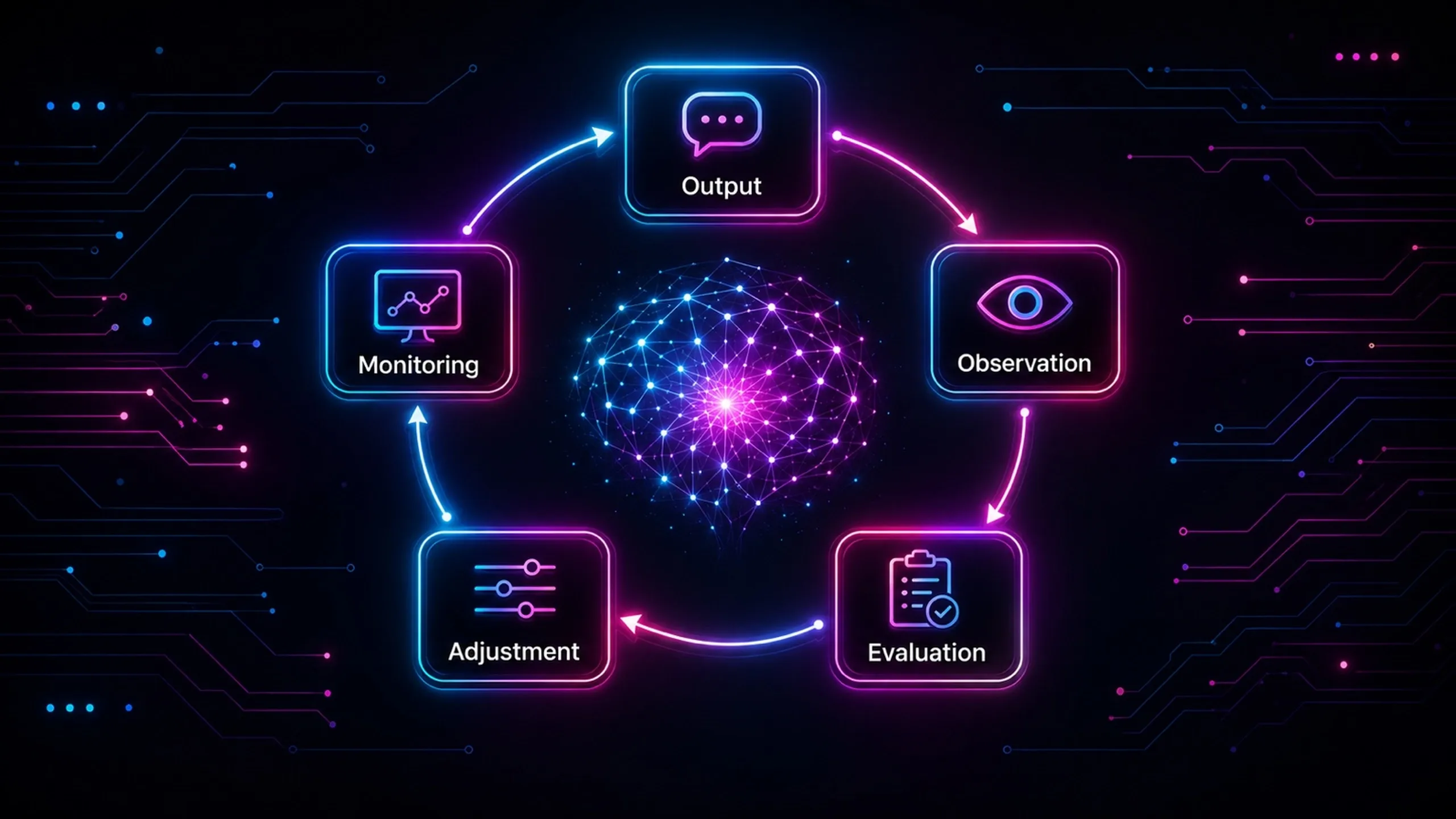
Feedback Loops
Improving AI Through Real-World Signals
Most AI systems do not improve simply because they are deployed. They improve when useful signals are captured, evaluated, validated, and fed back into the system responsibly.
A recommendation may be ignored. A chatbot answer may be corrected. A prediction may lead to a poor outcome. A human reviewer may flag an issue. All of these can become feedback.
Feedback loops connect AI behavior to real-world outcomes.
When designed well, feedback loops help AI systems become more accurate, useful, relevant, and reliable over time. When designed poorly, they can reinforce bias, amplify bad behavior, reward shallow metrics, or quietly degrade system quality.
What Is a Feedback Loop in AI?
A feedback loop in AI is a cycle where information from system performance, user behavior, human review, or operational outcomes is collected and used to improve future behavior.
This feedback may come from user ratings, human corrections, failed predictions, performance metrics, support escalations, conversion outcomes, moderation reviews, operational results, or observed user behavior.
For example, an AI search system may generate answers for users. If users repeatedly reformulate the same query after seeing a specific answer, that behavior may signal that the answer was not useful. If the team uses that signal to improve retrieval, ranking, content coverage, or answer boundaries, the feedback loop becomes part of the improvement process.
The important point is that the system does not only generate outputs. It also learns from what happens afterward.
Why Feedback Loops Matter
AI systems operate in changing environments.
User behavior changes. Products change. Business rules evolve. New edge cases appear. Data quality shifts. Operational conditions move over time. A model that performs well during testing may become unreliable after deployment if nobody monitors how it behaves in the real world.
Feedback loops help teams detect these changes before the system drifts too far away from useful behavior.
Without feedback loops, AI systems become static. With feedback loops, systems can adapt based on actual performance instead of assumptions.
This is especially important in environments where accuracy, trust, safety, and operational reliability matter more than novelty.
The important part is not only collecting feedback. The important part is deciding which signals should influence the system and how much weight they should carry.
Not every signal represents quality.
Feedback Collection vs Feedback Loop
Feedback collection is simply gathering data.
A feedback loop means the data leads to a controlled improvement process. Many organizations collect ratings, analytics, comments, corrections, and error reports but never connect them to review, decision-making, adjustment, and monitoring.
That is not a feedback loop. It is only observation.
A real feedback loop connects signal, review, decision, adjustment, and monitoring. Without the adjustment and monitoring stages, the system is only watching itself. It is not improving.
Feedback type matters because each signal has a different level of reliability. Human correction, behavioral data, performance metrics, and operational outcomes should not all be treated as equal.
Positive and Negative Feedback Loops
Feedback loops are not automatically beneficial.
A positive feedback loop improves the system over time. It captures useful signals, filters noise, includes human oversight where needed, and makes controlled improvements.
A negative feedback loop makes the system worse.
This may happen when biased data reinforces itself, when low-quality outputs become future training material, when shallow engagement metrics overpower more meaningful quality indicators, or when the system learns from its own unreviewed outputs.
For example, if an AI content system generates weak articles and those articles later become part of the system’s own retrieval or training layer, the quality of future outputs may gradually decline. The system starts reinforcing its own weaknesses.
That is why feedback quality matters as much as feedback quantity.
Feedback Loops and AI Governance
Feedback loops need governance because they change system behavior over time.
Teams need to define what feedback is collected, which signals matter most, who reviews the feedback, how changes are approved, what risks require escalation, and how performance is monitored afterward.
Without governance, feedback loops can quietly reinforce errors without anyone noticing.
This is especially important for AI systems used in search, analytics, customer support, finance, healthcare, hiring, legal operations, or business decision-making. The more important the outcome, the more important controlled feedback becomes.
Practical Examples of AI Feedback Loops
Feedback loops are not limited to model training. They also shape prompts, retrieval systems, workflows, thresholds, business rules, escalation paths, and operational processes.
These examples work best when feedback leads to a defined decision. The goal is not only to capture more signals. The goal is to improve the right part of the system.
The biggest mistake is confusing activity with learning.
Collecting feedback does not automatically improve the system. The feedback still needs evaluation, weighting, governance, and controlled adjustment.
A strong feedback loop does not let the system change blindly. It creates a controlled path from signal to improvement.
What Good AI Feedback Loops Look Like
Good AI feedback loops are intentional, governed, and measurable.
They define which signals matter, how feedback is reviewed, who approves changes, where humans remain involved, how drift is monitored, and what success looks like after an adjustment.
Good loops also recognize limits. Some signals are noisy. Some human feedback is inconsistent. Some metrics reward the wrong behavior. Some improvements in one area create trade-offs somewhere else.
A reliable feedback loop does not chase every signal. It filters, validates, and applies feedback according to the system’s purpose.
Final Thoughts
Feedback loops are one of the most important parts of practical AI because they connect system behavior to real-world outcomes.
They help AI systems improve, adapt, and become more useful over time. But they also introduce risk. If the wrong signals are used, feedback loops can reinforce bias, reward shallow behavior, contaminate future outputs, or make the system less reliable.
The best AI feedback loops are intentional.
They combine data, human judgment, monitoring, governance, and clear improvement criteria.
That is what turns AI from a one-time model into a managed system.