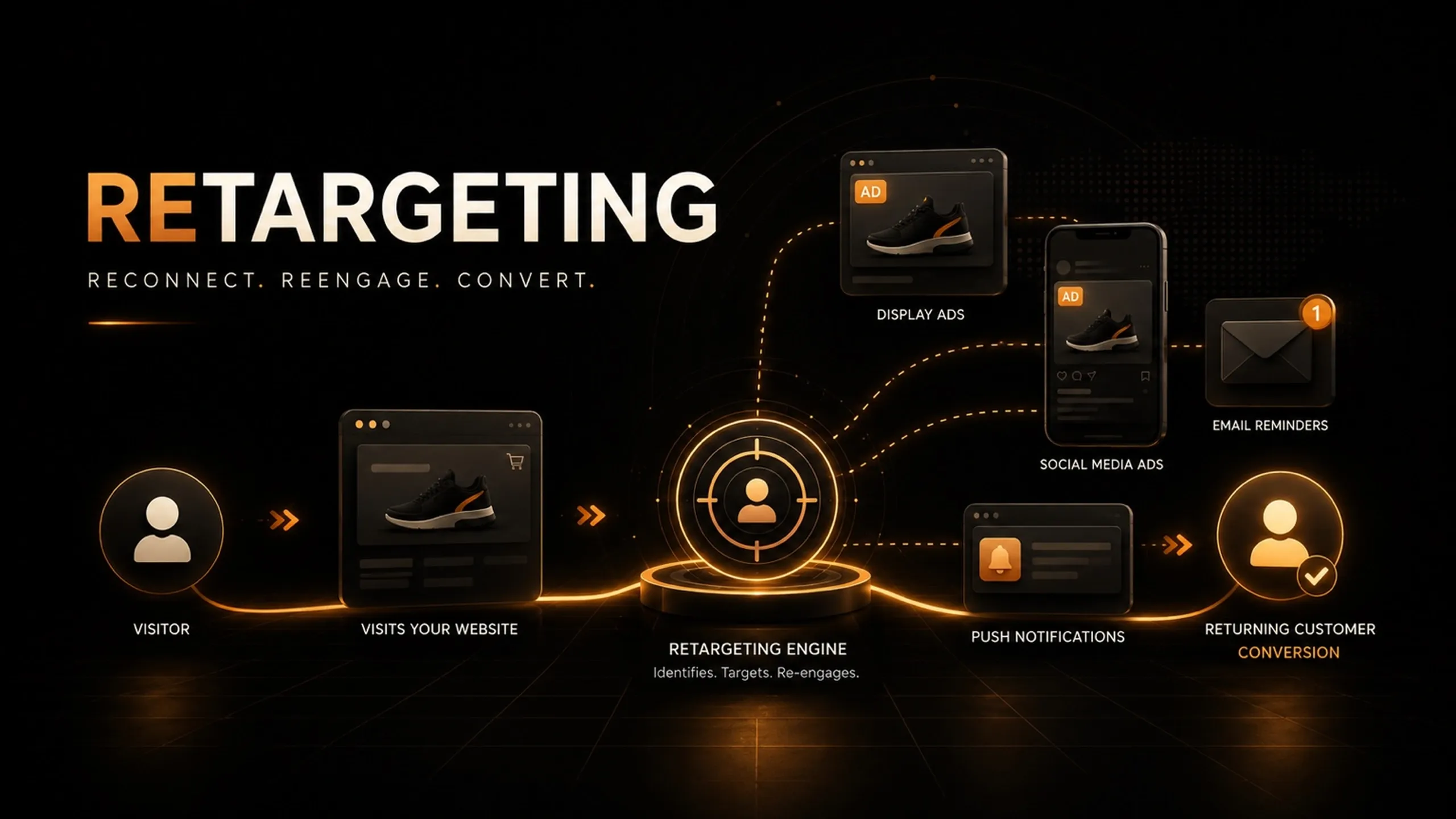
Retargeting
Follow Intent With Smarter Ads Strategies.
Retargeting is a paid advertising tactic that reaches people again based on their previous digital behavior.
It focuses on users who have already shown intent through actions such as visiting a website, viewing a product, opening a lead form, watching a video, engaging with social content, using an app, or searching for related terms.
Retargeting is not about following people everywhere. It is about using previous behavior to make paid media more relevant, timely, and controlled.
Instead of targeting a cold audience, retargeting uses behavioral signals to decide who should see a follow-up ad, what message they should receive next, and when the campaign should stop.
What Is Retargeting?
Retargeting is the practice of showing paid ads to people who have already interacted with a brand, website, product, app, ad, or platform touchpoint.
The most common example is website retargeting. A person visits a page but leaves without converting. Later, that person sees an ad on Google Display, YouTube, Search, Meta, Instagram, or another ad network that encourages them to return. Google Ads allows advertisers to create audience segments that include people who have visited a website before, while Meta ads supports website Custom Audiences based on visitors or specific website actions.
The most common example is a website visitor who leaves without converting and later sees an ad encouraging them to return. However, retargeting is not limited to website visits. It can also be based on product views, cart activity, search behavior, video engagement, social engagement, app events, or customer list matching.
Retargeting works because user intent is rarely completed in one session. People compare options, delay decisions, change devices, get distracted, or need more confidence before taking action.
Retargeting gives advertisers a way to re-enter that decision process with a more relevant message.
Retargeting vs Remarketing
Retargeting and remarketing overlap, but they are not always the same thing.
Remarketing is the broader re-engagement discipline. It can include email, CRM workflows, lifecycle campaigns, customer recovery, loyalty communication, and paid media.
Retargeting is narrower. It usually refers to paid ads triggered by previous behavior.
Concept | Main Focus | Typical Use |
|---|---|---|
Remarketing | Broad re-engagement | Email, CRM, paid ads, lifecycle communication |
Retargeting | Paid media reactivation | Website visitors, product viewers, video viewers, app users |
Dynamic Retargeting | Item-level ad personalization | Products, rooms, listings, packages, services |
Search Retargeting | Search behavior and audience layering | Reaching previous visitors when they search again |
Why Retargeting Matters
Retargeting matters because it gives paid media a second chance to act on known intent.
A user who has already visited a pricing page, product page, booking flow, contact form, or comparison page is not the same as a cold audience member. Their previous behavior provides context. Retargeting uses that context to adjust the message, landing page, audience window, bid, or creative sequence.
Retargeting is especially useful when:
Situation | Why Retargeting Helps |
|---|---|
Users compare before converting | Keeps the brand visible during consideration |
Products have longer decision cycles | Supports repeated exposure without restarting from zero |
Checkout or enquiry flows are abandoned | Brings users back to an incomplete action |
Paid acquisition traffic is expensive | Improves the value of previous traffic |
Content attracts early-stage users | Moves users from education toward action |
Products or services need trust | Reinforces proof, reassurance, and relevance |
Retargeting does not replace acquisition. It improves what happens after acquisition has already generated attention.
How Retargeting Works
Retargeting works by turning user behavior into audience eligibility for paid advertising.
A user performs an action. That action is captured by a tag, pixel, server-side event, app SDK, platform engagement signal, or uploaded audience list. The ad platform then places the user into an audience segment if they match the defined conditions.
From there, the advertiser can decide what campaign, ad, landing page, frequency, and duration should apply.
Step | What Happens |
|---|---|
Behavior occurs | A user visits, clicks, views, watches, searches, or engages |
Signal is captured | A tag, pixel, event, SDK, or platform source records the behavior |
Audience rule applies | The platform checks whether the user matches the segment criteria |
User enters segment | The user becomes eligible for retargeting for a set period |
Ad is served | The platform shows an ad across eligible placements |
Outcome is measured | Clicks, conversions, frequency, and return behavior are evaluated |
The quality of retargeting depends on the quality of the audience rule. “All visitors in 180 days” is rarely as useful as a cleaner segment such as “pricing page visitors in 14 days who did not submit a form.”
Retargeting Audience Logic
Good retargeting depends on audience logic. The platform can build audiences, but strategy decides which audiences are actually worth using.
Segment by Intent
The strongest retargeting audiences are based on meaningful behavior.
A user who spent ten seconds on the homepage should not receive the same campaign as a user who started checkout or visited a pricing page three times. Intent should shape the campaign structure.
Intent Level | Behavior Example | Campaign Role |
|---|---|---|
Low intent | General visit or short session | Light reminder |
Medium intent | Category, service, or article engagement | Education or proof |
High intent | Pricing, cart, form, checkout, booking | Conversion recovery |
Existing relationship | Lead, customer, subscriber | Lifecycle-specific offer |
Converted | Purchase, form submission, booking | Exclude or retain |
This is where retargeting becomes more precise than broad remarketing. It is not just “reach them again.” It is “reach this behavior with this next step.”
Use Recency Windows
Recency controls how long someone stays eligible after an action.
High-intent behavior usually deserves a shorter, more active window. Lower-intent behavior may need a longer but softer approach.
Window | Good Use |
|---|---|
1–3 days | Cart, booking, checkout, or form abandonment |
7–14 days | Pricing page, service page, product view |
30 days | General website or social engagement |
60–90 days | Longer consideration cycles |
180+ days | Customer list, reactivation, high-value decisions |
Long windows are not automatically better. They can increase reach, but they can also dilute intent.
Exclude Completed Actions
A retargeting campaign should know when to stop.
If someone purchased, booked, submitted a form, downloaded the offer, or completed the target action, they should usually leave that retargeting campaign. They may enter a new post-conversion campaign, but they should not keep seeing the same acquisition message.
Useful exclusions include:
Exclusion | Reason |
|---|---|
Recent converters | Avoid wasted spend |
Existing customers | Prevent irrelevant acquisition ads |
Support visitors | Separate help-seeking from buying intent |
Career page visitors | Remove job-seeking traffic |
Internal users | Keep staff and agency traffic out |
Unqualified locations | Avoid serving where the business cannot sell |
Retargeting is not only about inclusion. Suppression is what keeps it efficient.
Retargeting Message Sequencing
Retargeting should not rely on one ad repeated endlessly.
A better approach is sequencing: show different messages based on time, behavior, or depth of engagement.
Sequence by Funnel Stage
A user’s first retargeting ad may remind them of the product or service. A second message may provide proof. A final message may reduce friction or invite action.
Stage | Message Type |
|---|---|
Reminder | “You were interested in this category.” |
Reassurance | Reviews, testimonials, guarantees, case examples |
Clarification | Benefits, comparison, FAQs, objection handling |
Action | Book, enquire, purchase, register, return |
This avoids turning retargeting into repetition.
Sequence by Time
The timing of the ad should reflect how fresh the behavior is.
A user who abandoned checkout yesterday can receive a direct recovery message. A user who viewed a service page 30 days ago may need a softer reminder or educational angle.
Time Since Action | Message Style |
|---|---|
0–3 days | Direct and action-focused |
4–14 days | Proof, benefits, reassurance |
15–30 days | Reminder or alternative offer |
30+ days | Softer re-engagement |
Retargeting becomes stronger when time changes the message.
Sequence by Format
Different formats can support different stages.
Video can explain. Static ads can remind. Carousel ads can compare. Collection ads can show product variety. Search ads can capture active return demand.
The format should serve the user’s stage, not just the platform’s inventory.
Retargeting Creative
Retargeting creative should feel relevant without feeling intrusive.
The user’s previous behavior gives the advertiser context, but the ad should not sound like surveillance. A message like “Still looking at this?” may work in some categories, but it can also feel uncomfortable. In many cases, it is better to focus on usefulness, proof, value, or the next step.
Better Creative Angles
Behavior | Useful Creative Angle |
|---|---|
Product view | Product benefit, review, comparison, similar items |
Pricing page visit | Value explanation, consultation, guarantee, FAQ |
Cart abandonment | Return reminder, urgency, delivery, support |
Blog read | Related guide, checklist, service introduction |
Video completion | Deeper content, demo, case study, offer |
App inactivity | Feature reminder, saved progress, new update |
The best retargeting ads do not simply say “come back.” They give the user a reason to come back.
Creative Fatigue
Retargeting audiences are often smaller than cold prospecting audiences. That means fatigue can happen faster.
Signs of fatigue include rising frequency, falling click-through rate, weaker conversion rate, higher cost per conversion, and negative engagement. Creative rotation, shorter audience windows, exclusion logic, and message sequencing help reduce the problem.
Retargeting should feel controlled, not repetitive.
Retargeting Landing Pages
The landing page should match the behavior that triggered the retargeting.
If someone viewed a specific product, the ad should not send them to the homepage. If someone abandoned a booking flow, the ad should not send them to a generic blog post. If someone opened a lead form, the next step should be simple and direct.
Audience | Better Destination |
|---|---|
Product viewer | Product page or related category |
Service page visitor | Relevant service page with proof and CTA |
Cart abandoner | Cart or checkout path |
Pricing page visitor | Pricing, comparison, or consultation page |
Blog reader | Related guide or soft conversion page |
Video viewer | Deeper content or relevant landing page |
Retargeting is wasted when the audience is specific but the destination is generic.
Retargeting Campaign Structure
Retargeting campaigns should be structured around behavior, not just platform defaults.
A simple structure may separate audiences by intent:
Campaign Type | Audience |
|---|---|
Low-intent retargeting | Blog readers, homepage visitors, light engagement |
Mid-intent retargeting | Product, service, or category visitors |
High-intent retargeting | Pricing, cart, checkout, booking, form starters |
Engagement retargeting | Video viewers, social engagers, lead form openers |
Customer list retargeting | Leads, customers, lapsed users, subscribers |
This makes budget, creative, frequency, and performance easier to manage.
A more advanced setup may also separate campaigns by platform, recency, product category, region, lifecycle stage, or value tier. The structure should stay as simple as possible while still supporting meaningful differences in execution.
Retargeting Measurement
Retargeting can look highly efficient because it targets warm audiences. That does not always mean it created all the conversions it reports.
A user who already intended to return may click a retargeting ad before converting. In that case, retargeting may receive credit even if it did not fully cause the conversion.
Important metrics include:
Metric | What It Shows |
|---|---|
Audience size | Whether the segment can deliver |
Frequency | How often users see the ads |
Click-through rate | Whether the message attracts return interest |
Conversion rate | Whether users complete the next action |
Cost per conversion | Media efficiency |
View-through conversions | Possible impression influence |
Assisted conversions | Role in a longer journey |
Incrementality | Whether the campaign created extra value |
The most important question is not only whether retargeting converted. It is whether retargeting changed the outcome.
These mistakes make retargeting feel noisy instead of useful. Strong retargeting should be specific enough to improve relevance, but controlled enough to avoid waste and fatigue.
Best Practices for Retargeting
Retargeting works best when the campaign logic is narrow, intentional, and behavior-led. The goal is to reconnect based on meaningful signals, not to follow every visitor indefinitely.
Use Meaningful Actions
Do not retarget every possible interaction.
Use actions that indicate a real next step: product views, pricing visits, form starts, cart starts, booking starts, video completions, app inactivity, or repeated visits.
Match the Trigger
The ad should reflect the behavior that created the audience.
A pricing page visitor may need reassurance. A cart abandoner may need a return prompt. A blog reader may need more education. A previous customer may need a different product or renewal message.
Keep Windows Short
Fresh behavior is usually more valuable.
Use short windows for abandonment and high-intent actions. Use longer windows only when the buying cycle supports it.
Exclude Aggressively
Exclude users who already completed the action, entered another lifecycle stage, or are unlikely to be relevant.
This improves efficiency and prevents poor user experience.
Rotate Creative Early
Do not wait until performance collapses.
Retargeting audiences fatigue quickly. Refresh messaging, format, offer, and visual angle before the same users see the same ad too often.
Check Incrementality
Retargeting often gets credit because it appears near the end of the journey.
Use experiments, holdout audiences, audience exclusions, or conservative reporting to understand whether retargeting is adding value rather than only claiming it.
Final Thoughts
Retargeting is most useful when it acts on specific behavior.
It should not be a broad campaign that follows every visitor with the same message. It should use signals such as page visits, product views, search behavior, video engagement, app events, and customer lists to decide what follow-up ad makes sense.
Good retargeting is precise. It knows who to reach, why they matter, what they already did, what they should see next, when the campaign should stop, and how performance should be judged.