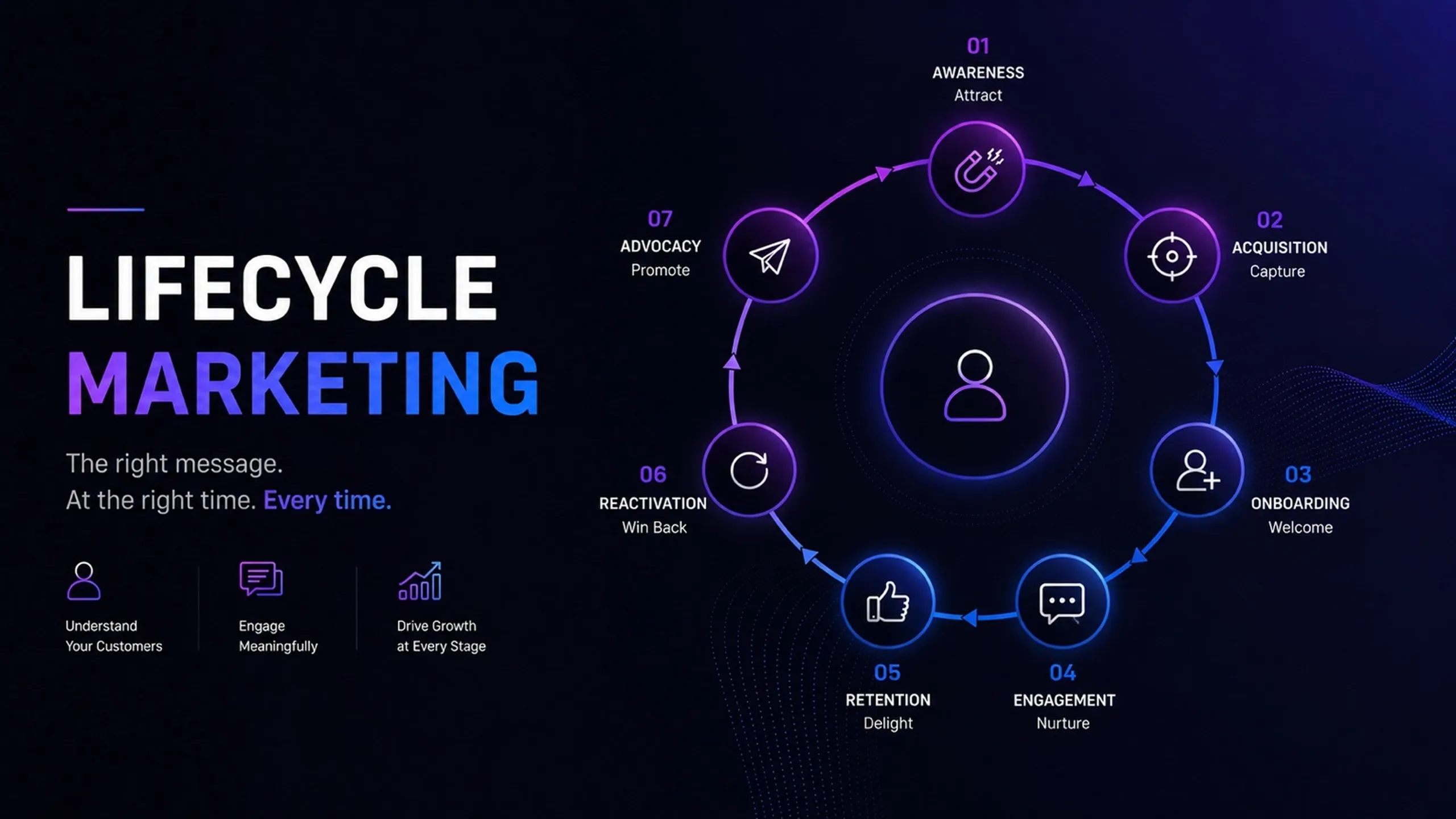
Lifecycle Marketing
The Right Message. At the Right Time. Every Time.
Lifecycle marketing is the practice of managing communication and experience across the full customer relationship, not just the first conversion.
It recognizes that users do not all need the same message at the same time. A first-time visitor, new lead, recent customer, repeat buyer, inactive subscriber, and loyal advocate are all in different stages of the relationship.
Lifecycle marketing is not about sending more messages. It is about sending the right message for the customer’s current stage.
At its best, lifecycle marketing connects acquisition, onboarding, engagement, retention, reactivation, and advocacy into one coherent system. It helps businesses move from isolated campaigns to relationship-based growth.
What Lifecycle Marketing Really Means
Lifecycle marketing is built around the idea that customer value changes over time.
A person may begin as an anonymous visitor, become a lead, make a purchase, return later, become loyal, lapse, reactivate, or eventually advocate for the brand. Each stage has different needs, questions, risks, and opportunities.
Traditional marketing often focuses heavily on acquisition: bringing people in, generating leads, or driving first purchases.
Lifecycle marketing goes further. It asks what happens after the first touchpoint, after the form submission, after the booking, after the purchase, and after the first experience.
That shift matters because growth does not come only from acquiring more people. It also comes from keeping the right people engaged, helping them succeed, encouraging repeat behavior, and increasing long-term value.
Why Lifecycle Marketing Matters
Most businesses lose value between stages.
A lead submits a form but receives slow follow-up. A new customer buys once but never receives onboarding. A guest completes a booking but gets generic communication. A subscriber becomes inactive but is never re-engaged. A loyal customer is treated the same as a first-time visitor.
These gaps weaken growth.
Lifecycle marketing matters because it helps close those gaps. It creates a structured way to guide people from one stage to the next with communication that matches their context.
It improves acquisition quality, conversion rate, onboarding, engagement, retention, repeat purchase, customer lifetime value, and brand loyalty.
More importantly, it reduces dependency on constantly buying or attracting new demand.
If every customer relationship resets after the first conversion, the business is always paying to start over.
Lifecycle Marketing vs Campaign Marketing
Campaign marketing is usually built around a specific push: a launch, promotion, email send, ad campaign, seasonal offer, event, or short-term objective.
Lifecycle marketing is built around the customer’s stage.
That distinction is important.
A campaign asks, “What do we want to promote?”
Lifecycle marketing asks, “What does this person need next?”
Traditional campaign marketing focuses on short-term conversions, while lifecycle marketing builds continuous, long-term relationships
Campaigns are still useful. They create momentum, visibility, and timely action. But without lifecycle thinking, campaigns can become disconnected. Different teams send different messages, timing becomes inconsistent, and users receive communication that does not match their relationship with the business.
Lifecycle marketing gives campaigns a larger structure.
It ensures that acquisition, nurturing, onboarding, retention, and reactivation are not treated as separate activities, but as connected parts of one customer system.
The Core Stages of Lifecycle Marketing
Lifecycle stages vary by business model, but most systems include a version of awareness, acquisition, onboarding, engagement, retention, reactivation, and advocacy.
The exact labels matter less than the logic behind them.
1. Awareness
Awareness is where people first discover the brand, product, service, or problem space.
At this stage, users may not be ready to buy. They may be searching broadly, browsing content, seeing ads, reading reviews, hearing about the brand from others, or comparing general options.
The goal is to create recognition and relevance.
Messaging should be clear, useful, and easy to understand. The business needs to help users identify the problem, understand the category, and see why the brand may be worth considering.
2. Acquisition
Acquisition is where a person takes an initial meaningful action.
This may be a website visit, content download, form submission, account creation, consultation request, booking, purchase, trial sign-up, or newsletter subscription.
The goal is not just to capture the action. The goal is to understand the quality and context of the action.
Where did the person come from? What did they show interest in? What stage are they likely in? What should happen next?
Acquisition without context creates weak lifecycle marketing because the system does not know how to continue the relationship.
3. Onboarding
Onboarding is the first structured experience after conversion.
This stage is often underdeveloped, but it strongly affects whether the relationship continues.
For a SaaS product, onboarding may mean helping users reach first value. For a hotel, it may mean pre-arrival communication, booking confirmation, expectation setting, and upsell opportunities. For a CRM or service business, it may mean next steps, setup, education, and handoff.
The goal is to reduce uncertainty and help the customer succeed quickly.
A strong onboarding stage confirms that the customer made the right decision.
4. Engagement
Engagement is where the relationship becomes active.
The customer reads, clicks, uses, replies, books, buys, attends, logs in, explores, or interacts with the brand in meaningful ways.
Engagement should not be measured only by surface activity. Opens, clicks, page views, and sessions can be useful indicators, but the real question is whether the user is moving closer to value.
Good lifecycle marketing uses engagement signals to guide the next step. A highly engaged lead may need sales follow-up. A customer using a feature repeatedly may be ready for expansion. A guest browsing spa pages before arrival may be interested in an experience offer.
Engagement becomes useful when it informs action.
5. Retention
Retention is the ability to keep customers active over time.
This may mean repeat purchases, renewals, return bookings, continued product usage, recurring engagement, subscription continuation, or ongoing service relationships.
Retention is where lifecycle marketing becomes most valuable.
Many businesses spend heavily to acquire customers, then underinvest in keeping them. That creates an expensive growth model because every lost customer has to be replaced.
Retention marketing uses timing, relevance, service, content, loyalty, and customer experience to maintain the relationship.
The goal is not simply to remind people that the brand exists. The goal is to continue creating value.
6. Reactivation
Reactivation focuses on people who have become inactive, dormant, or at risk of leaving.
This may include lapsed customers, inactive subscribers, abandoned accounts, disengaged leads, past guests, or users who have not returned within an expected timeframe.
Reactivation is different from acquisition because the person already has some relationship with the business.
The message can be more specific. It can reference past behavior, previous interest, incomplete actions, seasonal timing, renewal opportunities, or reasons to return.
The goal is to restart the relationship before it disappears completely.
7. Advocacy
Advocacy happens when customers actively recommend, review, refer, share, or support the brand.
It is valuable, but it should not be assumed.
Not every satisfied customer becomes an advocate. Advocacy usually requires strong experience, trust, timing, and a clear opportunity to participate.
Lifecycle marketing can support advocacy through review requests, referral programs, community building, loyalty recognition, testimonials, user-generated content, and post-purchase engagement.
The key is to ask at the right moment. A poorly timed review request or referral push can feel transactional. A well-timed one can extend a positive experience.
Lifecycle Marketing and CRM
Lifecycle marketing depends heavily on CRM quality.
A CRM should not only store contacts. It should help the business understand relationship stage, source, behavior, value, engagement, and next action.
Without clean CRM data, lifecycle marketing becomes generic.
A lead may be treated like a customer. A repeat customer may be treated like a new prospect. A high-value account may receive irrelevant messaging. A dormant contact may stay in the same workflow forever.
Good lifecycle marketing requires clear CRM fields, lifecycle stages, segmentation rules, consent status, source tracking, activity history, and ownership.
The CRM is where lifecycle strategy becomes operational.
Lifecycle Marketing and Segmentation
Segmentation is what makes lifecycle marketing precise.
Not every lead needs the same nurture flow. Not every customer needs the same retention message. Not every dormant user should receive the same reactivation offer.
Lifecycle segmentation may be based on:
- Lifecycle stage
- Source or campaign
- Product or service interest
- Purchase or booking history
- Engagement level
- Customer value
- Market or location
- Time since last action
- Intent signals
- Consent and communication preferences
The goal is not to create endless segments. The goal is to create segments that change the decision.
If a segment does not affect message, timing, offer, channel, priority, or follow-up, it may not be useful.
Lifecycle Marketing and Automation
Automation makes lifecycle marketing scalable.
Without automation, lifecycle marketing becomes difficult to maintain because each stage requires timing, triggers, rules, and follow-up.
Automation can support welcome flows, lead nurture sequences, abandoned cart reminders, booking confirmations, pre-arrival emails, post-purchase follow-ups, renewal reminders, win-back campaigns, review requests, and customer value alerts.
However, automation should not mean sending messages blindly.
The best lifecycle automation is built on clear logic.
A trigger starts the workflow. Conditions determine what should happen. Actions deliver the next step. Measurement shows whether the workflow is working.
If the logic is poor, automation will simply scale irrelevance.
Lifecycle Marketing and Customer Lifetime Value
Lifecycle marketing is closely connected to Customer Lifetime Value.
CLV improves when customers stay longer, buy more often, spend more over time, refer others, or require less effort to retain.
Lifecycle marketing supports this by guiding customers through the stages that create long-term value.
Acquisition brings the customer in. Onboarding helps them succeed. Engagement keeps the relationship active. Retention protects value. Reactivation reduces loss. Advocacy expands reach.
This is why lifecycle marketing should not be judged only by immediate conversions.
Some lifecycle activity creates value later. A strong onboarding sequence may reduce churn. A useful retention email may increase repeat purchase. A reactivation campaign may recover dormant revenue. A good post-experience request may generate reviews that improve future conversion.
Lifecycle marketing connects short-term communication to long-term customer value.
Lifecycle Marketing in Practice
Lifecycle marketing looks different depending on the business model.
For ecommerce, lifecycle marketing may include welcome emails, abandoned cart recovery, replenishment reminders, product recommendations, loyalty campaigns, post-purchase education, review requests, and win-back flows.
For hospitality, it may include pre-arrival communication, booking confirmation, upsell offers, itinerary support, post-stay follow-up, review requests, past guest reactivation, and loyalty messaging.
For SaaS, it may include trial onboarding, activation nudges, feature education, usage-based emails, renewal reminders, expansion prompts, churn prevention, and product adoption flows.
For lead generation, it may include form follow-up, qualification workflows, sales handoff, nurture campaigns, consultation reminders, re-engagement sequences, and CRM-based prioritization.
The mechanics change, but the principle stays the same.
Lifecycle marketing uses the customer’s stage and behavior to determine what should happen next.
The biggest mistake is treating lifecycle marketing as a set of automated messages.
Lifecycle marketing is not the workflow itself. The workflow is only the delivery mechanism.
The real strategy is deciding what each person needs at each stage of the relationship.
A Practical Lifecycle Marketing Framework
A strong lifecycle marketing system should be simple enough to maintain and structured enough to improve.
Start by defining the lifecycle stages that fit the business model. Do not copy generic stages blindly. A SaaS lifecycle, hotel lifecycle, ecommerce lifecycle, and B2B sales lifecycle will not behave the same way.
Next, define the key actions that move someone from one stage to another. A form submission, first purchase, booking confirmation, product activation, renewal, inactivity period, or repeat purchase may all represent important lifecycle transitions.
Then align communication to those stages. Each message should have a reason to exist. It should either reduce uncertainty, create value, move the user forward, recover risk, or deepen the relationship.
After that, connect the system to CRM, analytics, automation, and reporting. Lifecycle marketing needs data to work. Without reliable source, behavior, stage, and outcome data, the system becomes difficult to trust.
Finally, review performance over time. Lifecycle marketing should improve as more is learned about customer behavior.
A practical lifecycle system should answer:
- Who is this person?
- What stage are they in?
- What have they done?
- What do they likely need next?
- What should the business do now?
- How will success be measured?
The goal is not to build a perfect system. The goal is to build a working one that improves over time.
Conclusion
Lifecycle marketing is the difference between growth that depends on constant acquisition and growth that compounds through relationships.
It forces a shift from isolated campaigns to connected systems. From short-term wins to long-term value. From generic communication to stage-aware relevance.
If marketing stops at acquisition, the business pays to restart the relationship every time.
If the lifecycle is built properly, growth compounds.