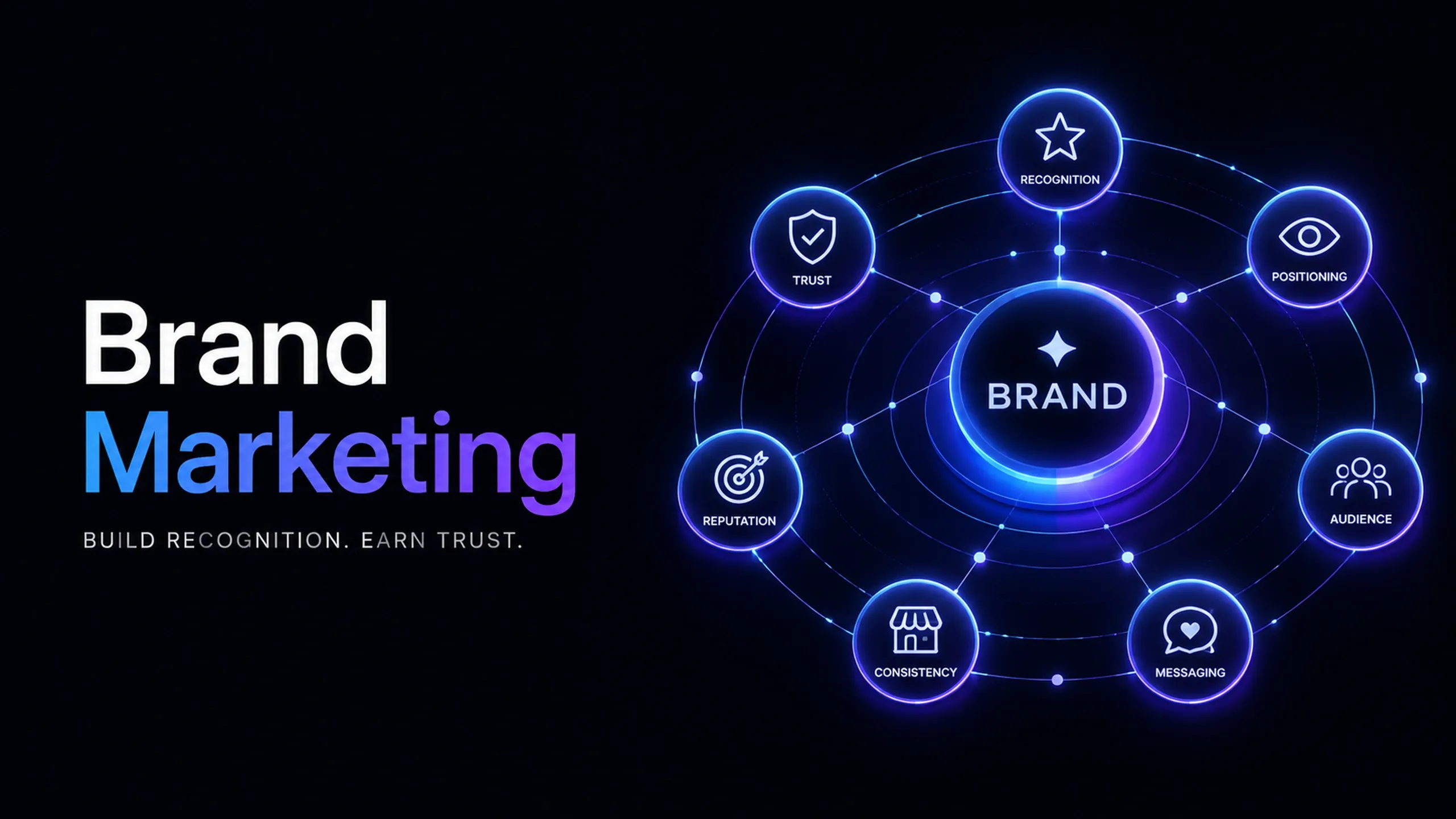
Brand Marketing
Building Recognition, Trust, and Demand
Brand marketing is the work of shaping how people recognize, understand, remember, and trust a business.
It is not only about logos, colors, slogans, or advertising campaigns. Those things matter, but they are only visible expressions of a deeper system: positioning, messaging, identity, reputation, consistency, and customer experience.
Brand marketing helps a business become recognizable before the sale, credible during evaluation, and memorable after the interaction.
Strong brand marketing makes future demand easier to create. It gives people a reason to remember the business, trust its claims, prefer its offer, and return when the need appears again.
What Is Brand Marketing?
Brand marketing is the strategic process of building and communicating a business’s identity, positioning, values, promise, and reputation over time.
It answers practical questions such as:
- What does this business stand for?
- Who is it for?
- Why should people care?
- What makes it different?
- What should people remember?
- Why should people trust it?
- How should it feel across every touchpoint?
Brand marketing is broader than promotion. It affects website content, advertising, design, customer service, product experience, social media, search visibility, reviews, sales conversations, internal culture, and post-purchase communication.
A brand is not what a business says once. It is what people consistently understand after repeated exposure.
Why Brand Marketing Matters
Most customers do not convert the first time they encounter a business.
They compare alternatives, ask for recommendations, search again, read reviews, check social proof, visit the website, review pricing, and evaluate whether the business feels credible.
Brand marketing matters because it shapes that evaluation before a direct conversion happens.
A strong brand can:
- Increase recognition
- Build trust faster
- Improve perceived value
- Reduce comparison friction
- Support pricing power
- Make advertising more effective
- Improve direct and branded search demand
- Strengthen customer retention
- Support word-of-mouth
- Make the business easier to explain internally and externally
Without brand marketing, a business may depend too heavily on short-term acquisition channels. It may need to keep paying for attention because people do not remember it, trust it, or understand why it is different.
Brand Marketing vs Performance Marketing
Brand marketing and performance marketing are often treated as opposites, but they should work together.
Performance marketing focuses on measurable actions such as clicks, leads, bookings, purchases, signups, and revenue. Brand marketing focuses on recognition, trust, preference, memory, and long-term demand.
Area | Brand Marketing | Performance Marketing |
|---|---|---|
Main Goal | Build recognition, trust, and preference. | Drive measurable actions and conversions. |
Timeframe | Long-term demand creation. | Short-term and mid-term demand capture. |
Main Question | Why should people remember and trust us? | How do we turn demand into results? |
Common Channels | Content, PR, social, brand campaigns, events, partnerships, website, customer experience. | Search ads, paid social, retargeting, landing pages, email, conversion campaigns. |
Measurement | Awareness, recall, branded search, sentiment, engagement, share of search, direct traffic, retention. | CPA, ROAS, conversion rate, revenue, lead volume, pipeline, booking value. |
Risk | Harder to attribute directly. | Can become expensive without brand demand. |
Performance marketing captures demand. Brand marketing helps create and strengthen that demand.
A business that only focuses on performance may become efficient at harvesting existing demand but weak at building future demand. A business that only focuses on brand may create attention without enough conversion structure. The strongest marketing systems connect both.
These elements work together. A brand with strong visuals but weak positioning will look polished but unclear. A brand with strong messaging but poor delivery will create disappointment. A brand with good service but inconsistent communication may fail to become memorable.
Brand Positioning
Brand positioning is the foundation of brand marketing.
It defines how the business wants to be understood in the market and why that position should matter to the customer.
A practical positioning statement should clarify:
- Target audience
- Core problem or need
- Category or market context
- Main value proposition
- Differentiation
- Proof or credibility
- Emotional or practical reason to choose the brand
For example, a boutique hotel may position itself around design, location, personal service, cultural experience, privacy, or direct connection to the destination. A medical device distributor may position around trust, traceability, aftercare, clinical support, warranty reliability, and service continuity.
The right positioning depends on what the customer values and what the business can consistently deliver.
Specificity makes the brand easier to understand and harder to replace.
Brand Identity
Brand identity is the visible and verbal system that makes a brand recognizable.
It includes more than the logo. A complete identity system may include:
- Logo
- Color palette
- Typography
- Image style
- Icon style
- Layout principles
- Tone of voice
- Naming conventions
- Taglines
- Templates
- Presentation style
- Social media style
- Website design language
Identity helps create consistency across touchpoints. When a customer sees a landing page, email, ad, proposal, social post, product guide, or booking page, the experience should feel connected.
But identity should not be decorative only.
A luxury hotel, industrial supplier, SaaS product, clinic network, and professional services firm should not all look or sound the same. The identity should express the brand’s position, audience, and level of trust required.
Good identity makes the brand easier to recognize. Good strategy makes that recognition meaningful.
Brand Messaging
Brand messaging turns positioning into words people can understand.
It explains what the business does, who it helps, why it matters, and why it is different.
Strong brand messaging should be:
- Clear and Specific
- Consistent
- Customer-aware
- Credible
- Easy to repeat
- Connected to real proof
Weak messaging often relies on vague claims:
- Innovative solutions
- Seamless experiences
- Best-in-class service
- Customer-first approach
- Digital transformation partner
These phrases are common because they sound safe, but they rarely create memory or trust.
Better messaging should connect the brand to a real outcome, context, or problem.
The message should make the brand easier to choose, not just easier to describe.
Brand Marketing Channels
Brand marketing does not happen in one channel. It is built through repeated exposure across many touchpoints.
Brand marketing becomes stronger when these channels reinforce one another instead of behaving like separate campaigns.
Brand Marketing and Customer Experience
Customer experience is where brand marketing becomes real.
A brand can promise speed, care, quality, expertise, simplicity, or reliability. But the customer decides whether that promise is true based on what actually happens.
For example:
- A hotel brand promising calm luxury cannot have a confusing booking flow.
- A SaaS brand promising simplicity cannot have messy onboarding.
- A clinic brand promising care cannot have poor follow-up communication.
- A logistics brand promising reliability cannot provide unclear tracking.
- A professional services brand promising expertise cannot publish generic content.
Brand marketing should not create a gap between expectation and reality.
The stronger the promise, the more important the delivery system becomes. That includes operations, training, product quality, service workflows, data accuracy, support, website experience, and communication.
Brand Marketing and SEO
Brand marketing and SEO are closely connected.
SEO helps people discover the brand when they search for topics, problems, services, comparisons, locations, products, and decisions. Brand marketing helps people remember and trust the brand after they discover it.
A strong brand can improve search behavior over time through:
- Branded search demand
- Higher recognition in search results
- Better click-through potential
- Stronger topical authority
- More natural backlinks and mentions
- Better engagement with content
- More direct traffic
- Stronger trust signals
Brand marketing also helps content feel less generic.
Many websites publish informational content, but not all content strengthens the brand. Good SEO content should answer the search intent while also reinforcing the brand’s point of view, expertise, structure, examples, and practical usefulness.
For content-led brands, SEO is not only a traffic channel. It is a brand-building system.
Brand Consistency
Brand consistency means the business presents itself clearly across repeated interactions.
Consistency does not mean every message must sound identical. It means the brand’s identity, tone, promise, and position should feel coherent wherever people encounter it.
A consistent brand usually has:
- Clear positioning
- Reusable messaging
- Visual guidelines
- Tone of voice rules
- Content standards
- Campaign templates
- Website design patterns
- Sales and support alignment
- Internal understanding
- Review and governance processes
Inconsistency creates friction.
If the website says one thing, the sales team says another, ads promote a different offer, and customer support behaves differently, the brand becomes harder to trust.
Consistency is not only a creative discipline. It is an operational discipline.
Measuring Brand Marketing
Brand marketing is harder to measure than direct response campaigns, but it is not impossible to measure.
The key is to use a mix of indicators instead of expecting one perfect attribution model.
Useful brand marketing signals include:
Metric | What It Can Indicate |
|---|---|
Branded Search Volume | More people are searching for the business by name. |
Direct Traffic | More users are visiting without relying on paid or referral clicks. |
Share of Search | The brand is gaining relative search interest compared with competitors. |
Organic Visibility | The brand is becoming more discoverable for relevant topics. |
Social Engagement | People are responding to the brand’s content, ideas, or identity. |
Mentions and Backlinks | Other sources are referencing the brand. |
Review Quality | Customers are expressing trust, satisfaction, or recurring issues. |
Returning Users | More people are coming back after previous exposure. |
Email Engagement | Existing audiences are staying connected. |
Conversion Assisted by Brand | Brand interactions support later decisions. |
Brand measurement should not be forced into the same model as performance marketing.
A brand campaign may not generate immediate conversions, but it can increase future search demand, improve conversion rates, reduce acquisition friction, and make performance campaigns more effective.
The process should not stop at launch. Brand marketing needs ongoing refinement as markets, customers, channels, and business priorities change.
The biggest mistake is thinking brand marketing is only about expression.
A brand becomes strong when strategy, communication, delivery, and customer memory all reinforce each other.
Best Practices for Brand Marketing
Good brand marketing is disciplined. It should make the business easier to understand, easier to remember, and easier to trust.
Start With Positioning
Do not begin with visuals or campaigns.
Start with the market position. Define who the brand serves, what it does best, what customers value, and why the business deserves attention. Without this, design and messaging become surface-level choices.
Use Specific Messaging
Avoid generic language.
Strong brand messaging should reflect the actual audience, problem, context, and value. If the message could fit any competitor, it is not specific enough.
Connect Brand to Experience
Brand marketing must match delivery.
If the brand promises simplicity, the website, onboarding, support, checkout, booking, or service process should feel simple. If the brand promises expertise, content and customer interaction should show real expertise.
Keep Identity Consistent
Recognition builds through repetition.
Use consistent visual systems, tone, naming, messaging, and content structure. Consistency helps customers build memory and confidence over time.
Balance Brand and Performance
Do not treat brand and performance as separate departments.
Brand marketing creates recognition and trust. Performance marketing converts demand. Both work better when they share positioning, messaging, creative direction, and measurement context.
Measure Long-Term Signals
Brand performance should be measured through multiple indicators.
Track branded search, direct traffic, organic visibility, mentions, reviews, returning users, engagement, and assisted conversion patterns. These signals help show whether the brand is becoming easier to recognize and trust.
What Strong Brand Marketing Looks Like
Strong brand marketing is clear, consistent, credible, and operationally supported.
It does not depend on one campaign or one design refresh. It shows up repeatedly across the business.
A strong brand marketing system usually includes:
- Clear positioning
- Specific audience understanding
- Consistent brand identity
- Practical messaging
- Strong website experience
- Useful content
- Aligned advertising
- Reliable customer experience
- Proof and reputation signals
- Internal understanding
- Measurement beyond last-click attribution
- Ongoing governance
The result is not just better awareness. The result is a business that becomes easier to recognize, explain, trust, and choose.
Final Thoughts
Brand marketing is the long-term work of building recognition, trust, preference, and memory.
It helps a business become more than another option in the market. It gives customers a clearer reason to notice, understand, remember, and choose the brand.
But strong brand marketing does not come from expression alone. It depends on positioning, messaging, identity, experience, consistency, and proof.
When brand marketing is handled properly, it supports every other part of marketing. SEO becomes more memorable. Ads become more recognizable. Content becomes more distinctive. Sales conversations become clearer. Customer experience becomes more connected.
A strong brand does not only look better. It makes the business easier to trust.